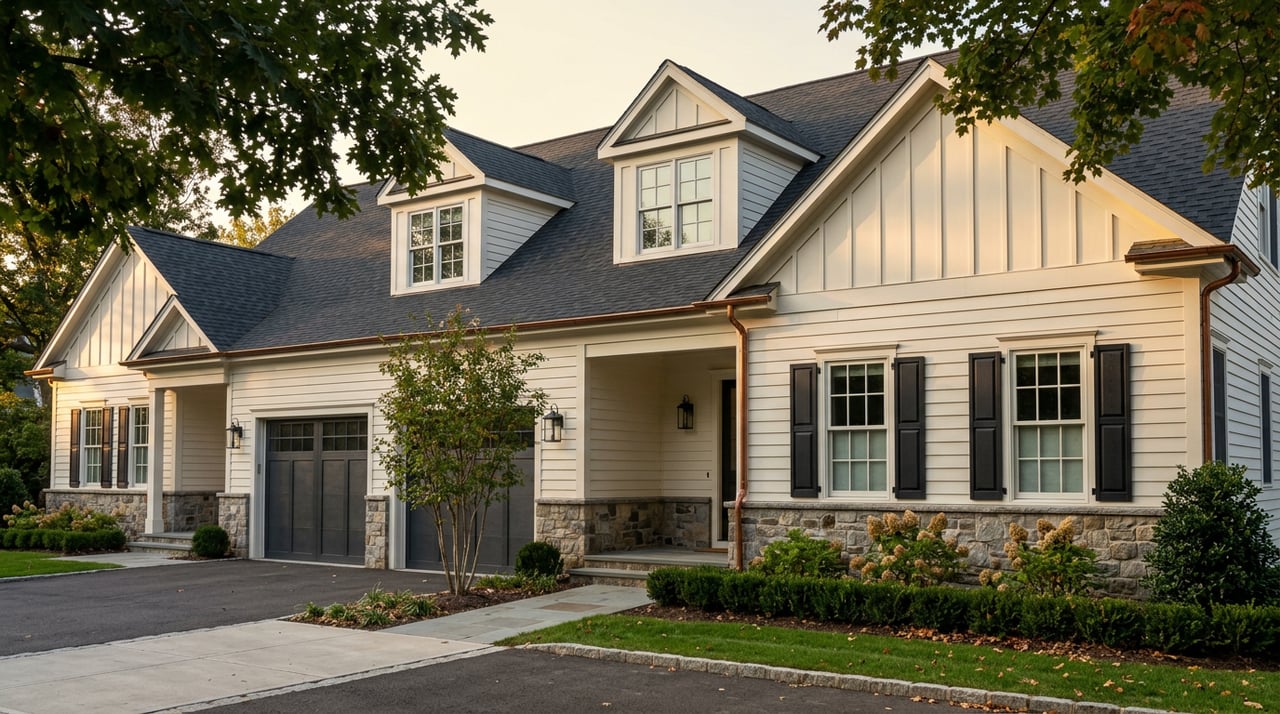
Walpole MA Housing Market Development in Downtown
September 3, 2026
September 3, 2026
Ask three different home-value tools what a house in Walpole is worth right now and you will get three different answers, and none of them will agree on the trend either. One says the median sale price fell to $565,000 in March 2026. Another puts the trailing twelve-month median at $751,250. A third clocks June 2026 sales at $799,999. That is not rounding error. That is what a small, unevenly mixed market looks like right before it changes shape.
I want to walk through why the numbers disagree, and then explain the actual reason: several residential projects are moving through Walpole's downtown permitting process at the same time, and together they are about to add a type of housing that barely exists in this town's current sales data. If you are comparing Walpole to Norwood, Dedham, or Medfield right now, the median price you find on a portal this month is measuring a different market than the one you will be shopping in a year from now.
Here is what the same market looked like across different trackers in the first half of 2026:
| Source | Metric | Period | Figure |
|---|---|---|---|
| Redfin | Median sale price | March 2026 | $565,000 (4 homes sold) |
| Homes.com | Median sale price | Trailing 12 months | $751,250 |
| Movoto | Median sale price | June 2026 | $799,999 |
| Zillow | Typical home value (ZHVI) | Current | $696,145 |
The Redfin number is the outlier that explains everything else. Four home sales is not a market, it is a coin flip. If two of those four happened to be starter capes and two were architect-built colonials, the median moves by six figures depending on which side of the sale you're standing on. Redfin's own data shows March homes taking 61 days to sell, more than four times the 14 days from the year before, which tells you the same story from another angle: fewer transactions, more variance, less signal.
Compare that to Movoto's June figure, built from 50 closed sales, more than the entire Redfin sample repeated more than ten times over. A market with 50 transactions in a month still isn't huge, but it smooths out the kind of one-off swing that a $2.4 million teardown-and-rebuild or a $340,000 estate sale can create in a four-home month.
This matters for a simple, practical reason. If you are pricing a listing or sizing up an offer using "the Walpole median" as your anchor, you need to know which Walpole median you're holding, what time window it covers, and how many transactions actually built it. A number without that context isn't a fact, it's a coin flip dressed up as data.
The reason this thin, swingy market is worth watching closely right now is that it is about to get less thin. Several separate residential developments are working their way through Walpole's downtown permitting process, and one of them cleared its final local hurdle this spring.
Toll Brothers filed the first project under Walpole's MBTA Multifamily Overlay District Bylaw: 67 townhouses spread across roughly 4.17 acres between Main, Maple, and East Streets, with two-story and four-story buildings and a private garage for every unit. The Planning Board's case file shows Site Plan Approval was granted on April 2, 2026, with a Certificate of No Appeal recorded April 29, meaning the project has cleared the point where an abutter could still block it locally. Getting there took months of back and forth. January's planning board minutes record a real debate over whether one-way traffic should be imposed on East Street and whether a 24-foot drive aisle was wide enough for fire access, the kind of granular fight that happens when a downtown that hasn't built at this scale in decades suddenly has to.
A few blocks over, the former Gilmore Building Supplies site at 1015 East Street is becoming The Sanctuary on East, a six-story, 142-unit apartment building approved through what Massachusetts calls a Friendly 40B, a process where the town and developer negotiate the affordability terms together rather than through a contested comprehensive permit fight. The Town of Walpole says 36 of those units will be reserved for households earning at or below 80 percent of area median income. The building's amenity package includes a putting green and an indoor golf simulator, a detail that tells you this project is aimed at renters who could otherwise be shopping the for-sale market.
Near the train station, a project at 130 West Street would replace the former Drycrete Waterproofing site with 95 market-rate apartments, mostly studios and one-bedrooms, plus first-floor commercial space. And on Main Street, the old Bank of America building at 979 is being converted into a small four-story condo building with ground-floor restaurant space, the kind of ownership product downtown Walpole essentially doesn't have today.
None of this happened by accident. Walpole passed new zoning to comply with the state's MBTA Communities Law, which requires towns served by the T to allow multifamily housing as of right somewhere within a half mile of a station. Sarah Khatib, founder of the downtown business group Destination Downtown, told the Boston Globe the town wasn't expecting the change to remake the area overnight.
"We're not expecting this to transform our downtown or lead to a housing production boom, but I think it has the potential to be productive."
She was right that it's not a boom in the traditional sense. The new housing is modest against a town of roughly 28,000 people. But it is more ownership and rental product in one small radius than downtown Walpole has absorbed in a long time, and it is arriving into a sales market thin enough that four home sales in a month can swing the median by 40 percent.
If you're comparing towns right now, the practical takeaway isn't that Walpole is getting cheaper or more expensive. It's that the market you're measuring is about to include a category of housing it currently lacks almost entirely: new-construction townhomes and condos priced for ownership, sitting a short walk from the train platform.
For a seller with an existing single-family home outside the downtown core, in the neighborhoods further from Main and East Streets, this shift touches you less directly. Your buyer pool is still shopping detached homes on quarter-acre and half-acre lots, not 678-square-foot condo units. The median swings you see on portals reflect a citywide blend, but your comparable sales are still your comparable sales.
For a buyer looking at downtown Walpole specifically, the calculation is different. If the Toll Brothers townhomes and the 979 Main Street condos come to market over the next year or two, they will give you a new-construction ownership option that didn't exist as recently as last year, likely priced at a premium to resale housing nearby given the finish level and garage parking. Whether that pulls prices up or down for existing downtown-adjacent resale inventory depends on how quickly the units absorb and how many buyers were already circling that area waiting for exactly this kind of product.
For anyone weighing a rental purchase or landlord strategy, the apartment supply at Sanctuary on East and 130 West Street is the more relevant story. Two hundred and thirty-plus new apartment units within walking distance of the commuter rail station is a meaningful addition to Walpole's rental stock, and new supply at that scale tends to put a ceiling on rent growth for existing rental units nearby, at least in the near term while the buildings lease up.
When will the Toll Brothers townhomes actually be listed for sale? Site Plan Approval cleared in April 2026 with no appeal filed, which means Toll Brothers can move toward construction. The town's project record doesn't specify a delivery date, and builders typically don't list finished units for sale until vertical construction is well underway, so treat any timeline before groundbreaking as an estimate rather than a commitment.
Does this affect home values outside downtown Walpole? The new units are concentrated within a half mile of the commuter rail station, which is the area the MBTA Communities Law required the town to zone for multifamily housing. Single-family neighborhoods further from downtown aren't subject to the same overlay district and aren't seeing comparable new supply.
Why do Redfin and Zillow show different numbers for the same town? They're measuring different things. A median sale price reflects actual closed transactions in a given window, and with as few as four sales in a slow month, that figure can swing sharply based on which specific homes happened to sell. A typical home value index like Zillow's ZHVI is a model estimate meant to smooth out that kind of month-to-month noise, which is why the two rarely match exactly.
If you're trying to figure out what any of this means for a specific property, whether you're weighing a sale near downtown before the new inventory lands or sizing up what a Toll Brothers townhome might mean for a nearby resale listing, I'd rather walk through the actual comparable sales with you than point you at a portal average. Reach out to Kiky Papadopoulos and let's talk through your particular corner of Walpole.
This article is general information, not legal, tax or financial advice. Consult a qualified professional about your situation.
Stay up to date on the latest real estate trends.
Get assistance in determining current property value, crafting a competitive offer, writing and negotiating a contract, and much more. Contact Kiky today to discuss all your real estate needs!